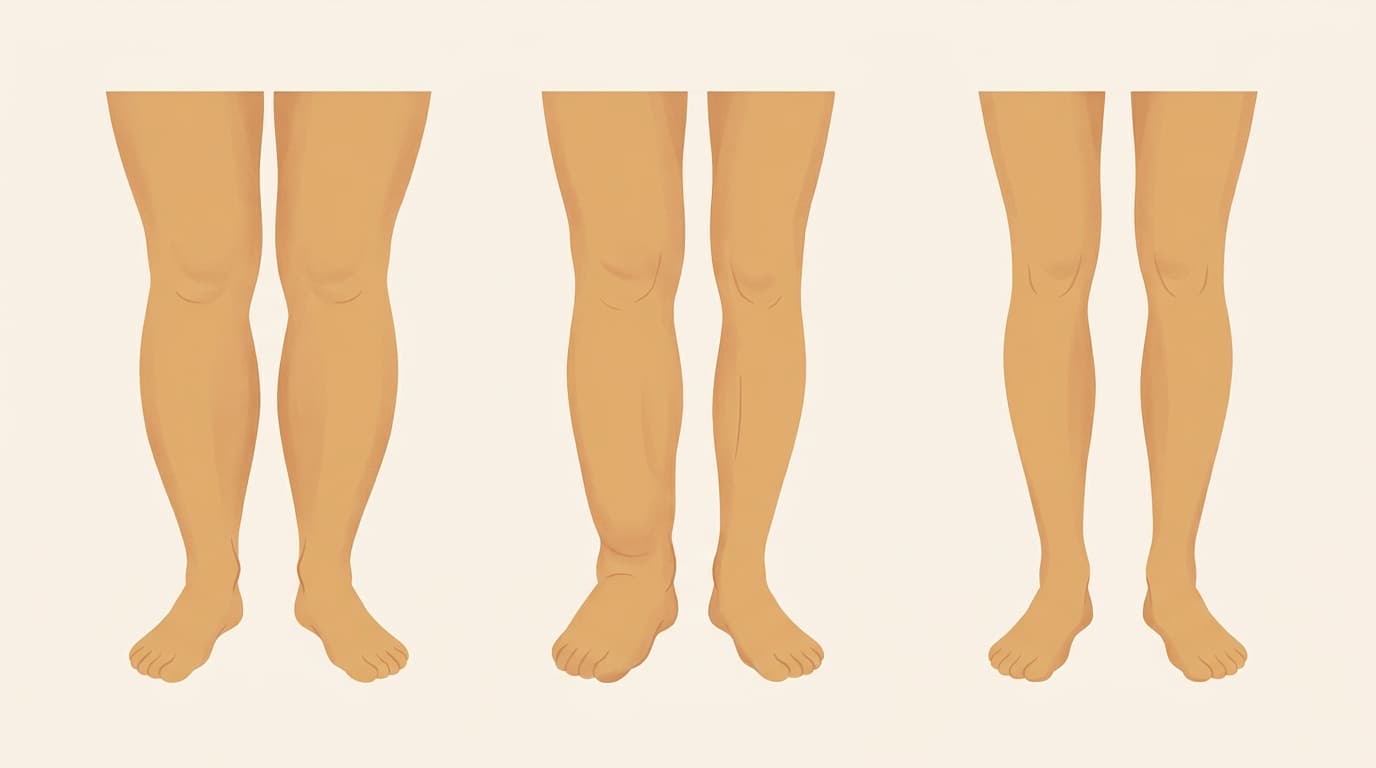
The quickest separators: lipoedema is symmetrical, painful to touch, bruises easily and spares the feet; lymphoedema swells one side more, includes the foot and pits when pressed; ordinary weight gain is painless, proportionate, and responds to diet — lipoedema legs don't.
"Have you tried losing weight?" If you have lipoedema, you probably have — and watched your waist shrink while your legs didn't change. This guide lays out how the three conditions actually differ, so you can bring the right observations to the right clinician.
The side-by-side
| Sign | Lipoedema | Lymphoedema | Weight gain |
|---|---|---|---|
| Symmetry | Both legs, strikingly equal | Often one limb (or one worse) | Even, whole body |
| Feet | Spared — cuff stops at the ankle | Involved — puffy foot, boxy toes | Proportionate |
| Pain | Tender to touch and pressure | Heaviness and tightness more than pain | Painless |
| Pitting | Little to none | Pits early (a pressed dent remains) | None |
| Bruising | Easy, often unexplained | Not typical | Not typical |
| Diet response | Legs barely change | Swelling unaffected | Responds |
| Typical onset | Puberty, pregnancy, menopause | After surgery/infection, or gradually | Any time |
Why this is worth getting right
These are different conditions with different treatments: compression and specialised liposuction help lipoedema; decongestive therapy treats lymphoedema; neither is fixed by dieting, and misdiagnosis costs years. To complicate things, long-standing lipoedema can strain the lymphatics until a mixed picture develops (sometimes called lipo-lymphoedema) — feet that were always slim starting to swell is the classic sign the picture is shifting.
Three checks you can do at home
- The ankle test. Does the heaviness stop at the ankle, leaving a slim foot? Points to lipoedema. Puffy foot too? Think lymphoedema.
- The press test. Press a thumb firmly into the swelling for ten seconds. A dent that stays points to lymphoedema.
- The touch test. Does moderate pressure — a massage, a child climbing on your lap — genuinely hurt? Tenderness like that is typical of lipoedema, not of weight.
None of these is a diagnosis; together they're a pattern worth describing, precisely, at an appointment.
What to say to your doctor
Skip the word "swollen" if what you mean is disproportion — it sends clinicians down the fluid path. Instead, be specific: "My legs are out of proportion with my upper body, they're tender to pressure, they bruise easily, my feet are slim, and dieting changes my waist but not my legs. Could this be lipoedema?" A specific pattern is much harder to dismiss than a general complaint.